
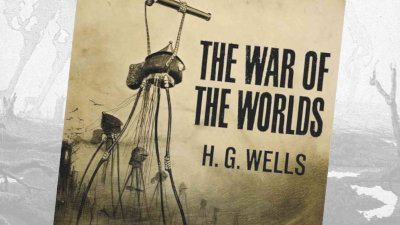
 H.G. Wells’ The War of the Worlds established the alien invasion trope in a science fiction classic.
Written in 1898, this is a sci-fi adventure that highlights the danger of hubris, as the conquering martians tear down man’s great industrial civilization. It contains everything we now expect of an alien invasion story.
Mysterious cylinders crash-land outside London. The Martians deploy towering three-legged tripods armed with devastating heat-rays, and poison gas.
The military might of the British Empire is quickly annihilated by superior technology. Mass-destruction ensues. The survivors flee and humanity appears doomed, until Wells reveals the science that undercuts almost all alien contact stories: the Martians have no resistance to Earth’s bacteria.
First, the Martians demolish the hubris of the British Empire with their successful colonization of earth. Then hubris humbles the Martians themselves. Their fatal oversight fails to account for the thing that is more powerful than human or Martian; nature.
This isn’t an action-adventure story of heroic resistance, but a bleak warning of existential crisis. Wells depicts military failure, near-instant panic and societal breakdown. He shows how the thin veneer of civilization cracks in the face of an invincible enemy.
Well’s first-person narrator is an unnamed everyman, an amateur astronomer living near the landing site. He sends his unnamed wife to safety early in the invasion, and then records his journey of survival, breakdown and reunion. The survivors he meets along the way include an artilleryman with PTSD, clutching at a fantasy of an underground resistance. Most devastated of all is the curate, Nathaniel, for whom the invasion is the biblical apocalypse.
Flip the script
Wells flips the script on nineteenth-century colonialism, as the conquering British Empire becomes the frail, colonized people. He demolishes the Victorian beliefs in human supremacy, technological dominance and peak evolution. The Martian sephalopoids, with their technology and towering intellect present an invincible, other-worldly alien enemy.
Initially this plays out in the narrator’s locale, small-town England. Later, we move to the coast among boatloads of refugees, where the might of the British navy is quickly destroyed.
In Well’s ironic ending, humanity is powerless to resist. There’s no heroic fightback by the under-dog, humanity is down and facing extinction as the Martians terra-form the earth. Rather it is the smallest of God’s creations, the bacteria that provides man’s Deus Ex Machina salvation.
Legacy
Wells’ measured, mannered, Victorian prose doesn’t make for an all-action thrill-ride. It’s thorough, solid and wordy, in the best traditions of his day, so best not judged by our standards.
The War of the Worlds contains big themes in a world-shattering story that continues to inspire other authors, film-makers and composers. Each generation re-interprets the alien invasion from Orson Welles’ shock mockumentary 1930’s radio play, the 1950’s movie classic, Jeff Wayne’s 1970’s concept album and the 2005 Spielberg/Tom Cruise re-imagining. Ridley Scott’s Alien, John McTeirnan’s Predator, Roland Emmerich’s bombastic Independence Day (laughably resolved by Jeff Goldblum’s computer virus), and countless sci-fi novels are all fueled by Wells’ original.