
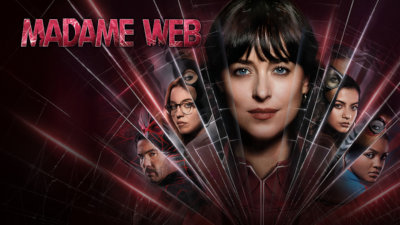
 Is Sony’s Madame Web a cynical cash-grab or an attempt to make an alternate super-heroine movie? Is it a bold departure or a hotch-potch of nonsense? A feminist triumph or a woke disaster?
All of the above. Yes, I finally caught up with a two-year old, franchise-adjacent, comic-book adaptation that everyone hated at the time. The main moral of the story is: learn how to do CPR.
Daktoa Johnson ‘stars’ as gutsy NY paramedic Cassandra Webb. See what they did there? Cassandra, as in Greek mythology’s seer of the future? And Webb as in… web. There’s a lot of web references. Not one of them about the Internet, even though it’s set in 2003. Spot the Blockbuster video stores in the background
Johnson wanders aimlessly through this superhero origin story for two hours in a state of confusion, trying to save three teenage girls from an evil version of Spider-man. Tahim Rahir’s Bad-Spidey wants to kill the girls because of a dream in which they become superheroes and kill him in the future. So he needs to kill them in the present to change his future. Time paradox number one and we’re already in trouble.
Rewind: in 1973, Cassandra’s mother goes to Peru chasing down magic spiders while pregnant, all because… plot. ‘Cassie’ grows up an orphan with a tragic backstory who begins to experience visions of the future. Somehow this turns into four young female characters racing around New York landmarks trying to escape a super-powered serial killer.
Sticky or not
As far as I can tell, Sony tried to launch a franchise using whatever Marvel side-characters it still holds the rights for. Apparently Madame Web appears briefly in the comics as an elderly, blind psychic who people consult when they want to know the future.
So why not turn her into a pretty, thirty-something, single, independent, professional woman with a savior-complex and mommy-issues? That’ll work.
Spinning a different web
Cassie’s superpower is future sight. No super-strength, super-speed, flying, energy-zapping or martial arts bad-assery(TM). The premonition sequences are disturbingly vivid at the beginning. That’s a plus. In theory this makes her an ideal alternative hero, opposing an invincible enemy. Until she ’embraces her destiny.’ Mastery of the future makes her nigh-on unstoppable.
Her three surrogate kids are ordinary teenagers (in their mid-twenties, but hey…) with no powers, agency, or common sense. But they’re self-aware and reference teen-slasher movies. One’s white, one’s black and one’s Latino. It’s almost like there’s a check-list…
Black Widows and orphans
This movie dares tread where Birds of Prey sank into the quicksand. United by a common backstory of broken homes, loss, rejection and displacement, Cassie and the three teens become the poster-girls of the found-family trope. Sisters doin’ it for themselves, flipping the bird to the patriarchy.
So why doesn’t it feel that way?
A fragile web
Johnson just doesn’t have the range to pull this off. She pouts and cries prettily enough, but can’t embody her character arc. It’s still not the worst performance in the movie, that’s reserved for Sydney Sweeney, who is stand-out terrible in every single scene.
The three ‘teens’ are caricatures of whining adolescence. A psycho super-villain comes to claim them? Honestly you’d let him. And as for their super-hero selves in the future? Who let the kids out at Halloween?
Tahir Rahim fully commits to the villain by sheer charisma and force of will, but honestly doesn’t look like he knows what he signed up for.
Meanwhile Adam Scott from Severance underplays the whole thing as Uncle Ben Parker.
Magic spiders
This is the high-concept McGuffin that powers the whole thing. If you can’t accept the magic spiders, just go home, because from there, the script lurches from plot-point to ham-fisted plot-point with all the subtlety of a jack-hammer. It’s convoluted, non-linear, and strained to breaking by time-paradoxes each time Cassie glimpses the future and changes it.
There’s a heinous plot reveal in which a mysterious Peruvian mentor-dude pops up like Gandalf to exposition the hell out of Cassie’s powers, then disappears. Cassie crosses into the past to reconcile with her mother and discovers her whole, best self. Or something.
Then we get a whole lot of whizzy-smashey-explodey climax in a burning building, executed with some flare (pun intended).
Johnson later claimed the whole thing was re-written and edited by committee, without a clear vision. That figures.
A spidery scrawl
The writing isn’t the only issue. None of the principal actresses knows how to deliver the lame dialog. Rahir pours every ounce of masculinity into it, but doesn’t seem convinced.
Tellingly, Adam Scott outclasses everyone each time he quietly drops a line; the credible Everyman in a world of plastic Barbies.
A lack of bite
As my line of spider-based, sub-title puns fizzles out, so does the ending of Madame Web. Gloriously happy in the shared loft apartment, the found-family argue over take-out food. Still pre-super-powers, they’re just as whiny and annoying as the last two hours.
Blind, chair-bound Cassie exudes an overwhelming and cloying smugness. Dakota Johnson’s only winning talent lies in those big expressive eyes, and the director chooses to hide them behind giant, wrap-around sunglasses.
S.J. Clarkson is an experienced TV director of fantasy and super-hero shows. Could she not whether the storm of studio interference? Was it the wrong project, wrong star, wrong script, wrong concept? Did Sony try to make a franchise out of the few Marvel side-characters they still hold rights for? Too many super-heroes, not enough magic dust? Whichever you believe, it joins a growing line of under-performing female-led and female-directed projects.
It’s barrel-scraping nonsense.
It could be worse. Have you seen She-Hulk? Star Wars’ The Acolyte?
10% on Rotten Tomatoes. That’s a record.
I’ve seen far, far worse than this. Madame Web isn’t terrible. It just misses the mark.